Flagged in the act
When an app reaches for your mic or camera in the background, you get an alert — even on the lock screen.
Get alerted when an app uses your camera or microphone in the background.
One-time $0.99 · No account · Nothing leaves your phone

You talk about something… then you see the ad. Usually that's just data tracking — but some apps really do reach for your mic and camera in the background. Spytrap turns on the light, and tells you when it happens.
⌖ move your cursor — the darkness keeps records
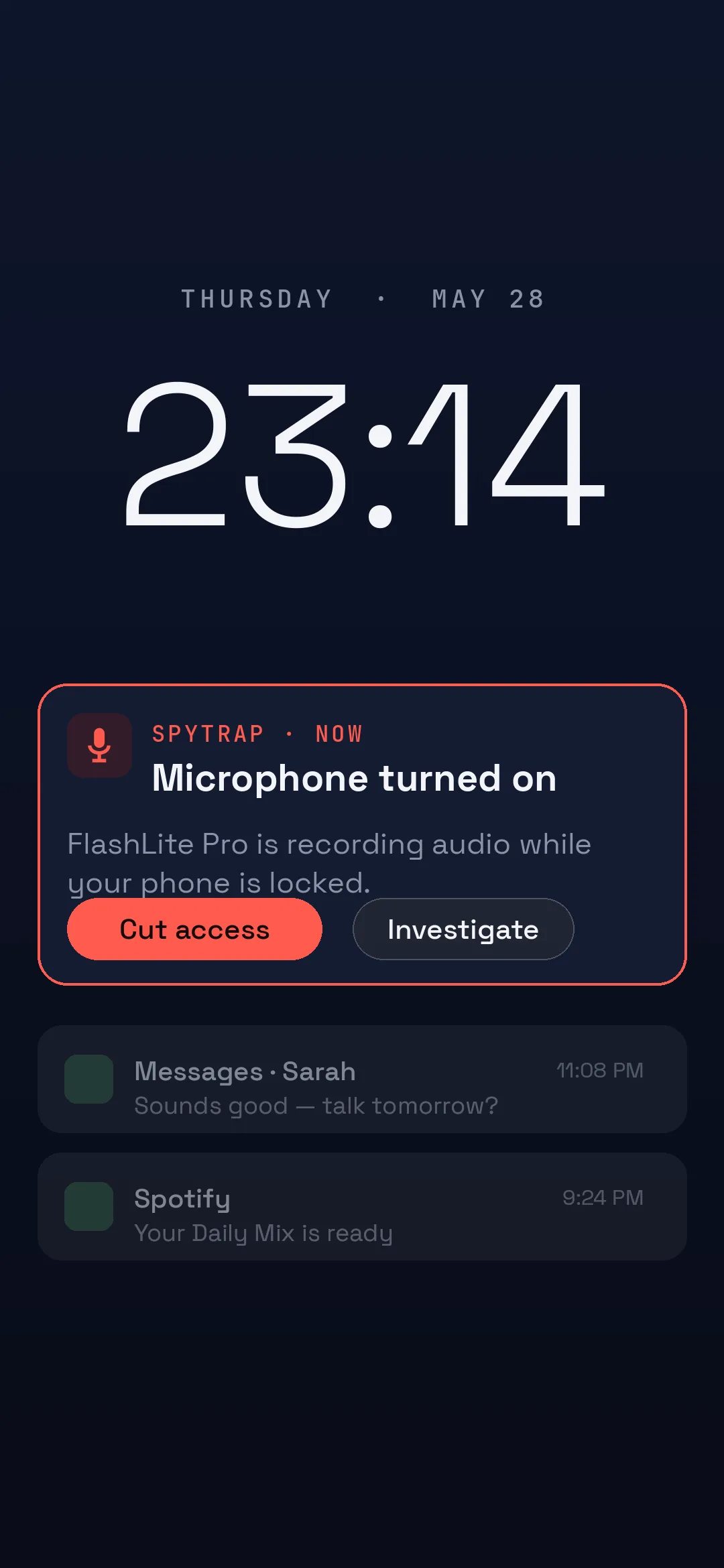
When an app reaches for your mic or camera in the background, you get an alert — even on the lock screen.
A weekly rundown of the apps reaching for your sensors, ranked by how often they did it.
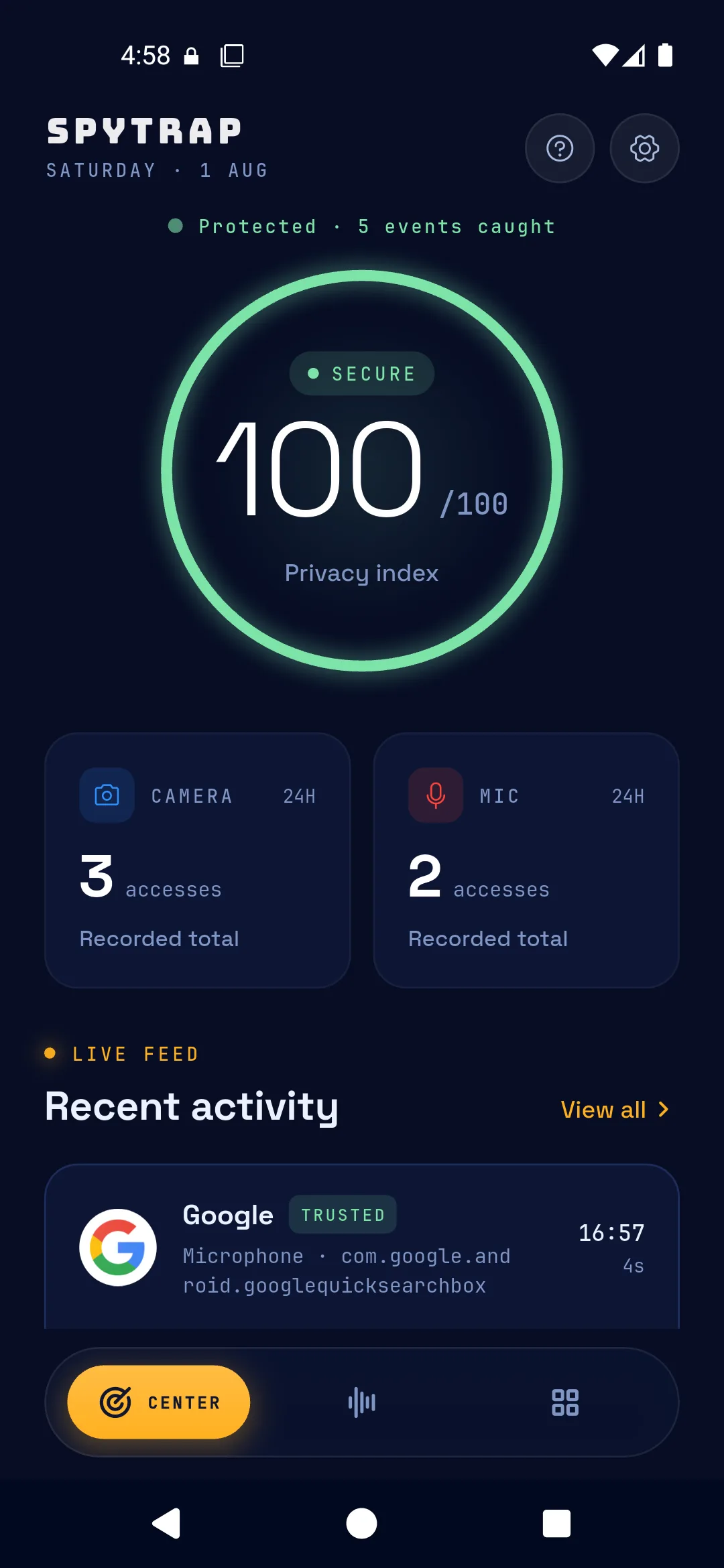
One number that sums up recent flagged activity.
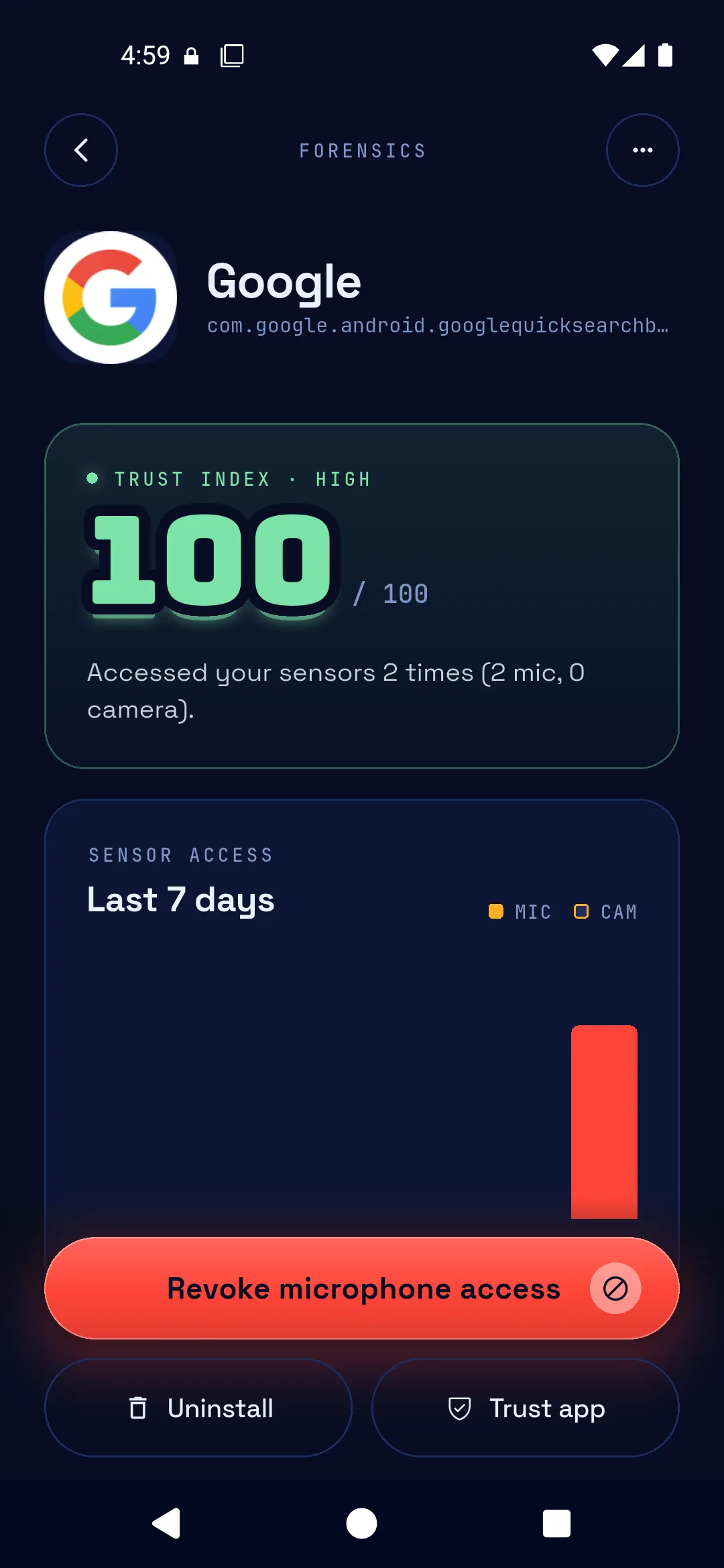
A trust score for each app it has logged — then revoke, uninstall or trust it.
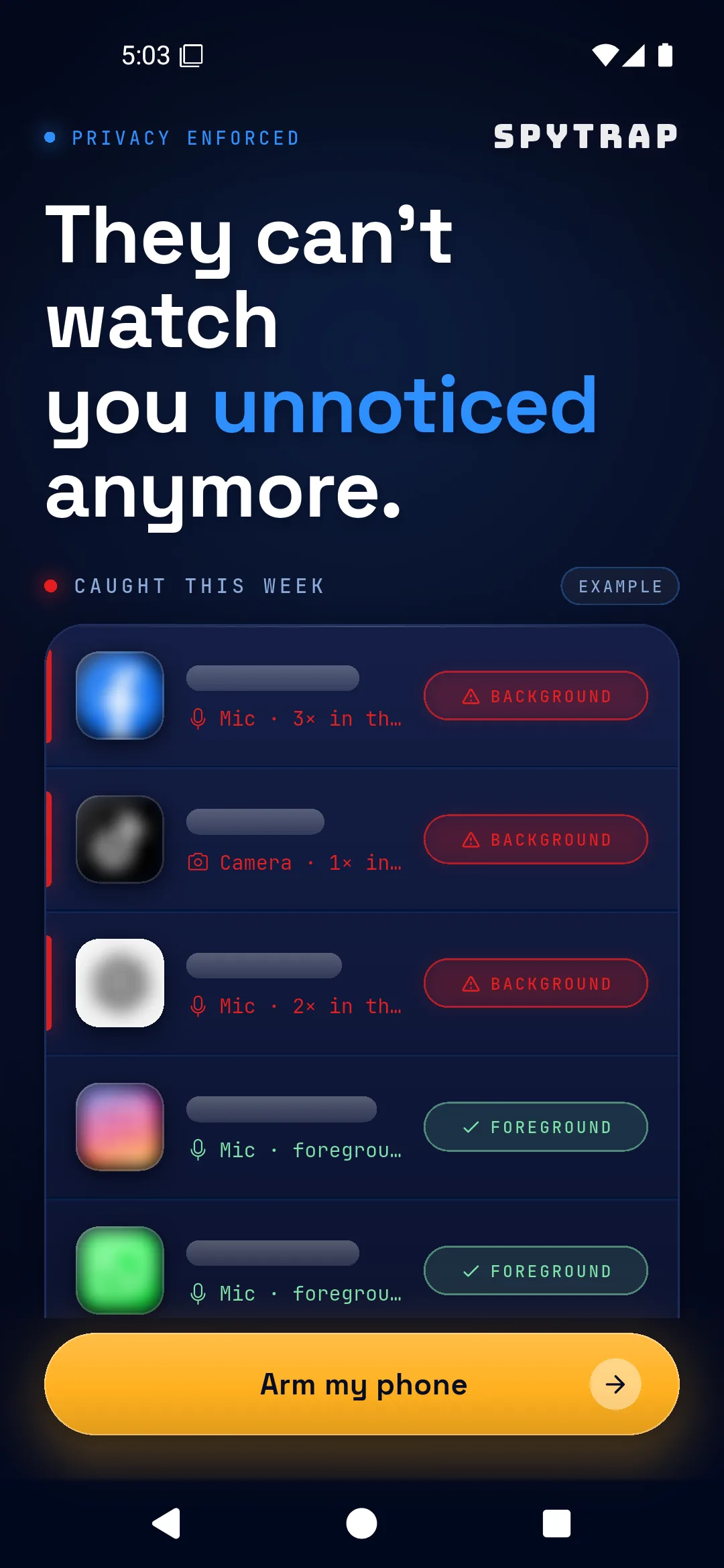
Know when an app turns on your camera or mic while you're not looking.
Background access, screen off — you still get the alert.
Each access it sees, with the time and how long it lasted.
On-device only. No account, no tracking, no ads.
There's no server to hack, because nothing is ever sent to one. Spytrap detects that a sensor was used — never your photos, video, or audio.
Read the privacy policy →Spytrap runs a background service on your Android phone that watches the camera and microphone at system level. When it sees an app activate a sensor, it records four things:
It does — while the sensor is on, and then it's gone. The privacy indicators introduced in Android 12 have no memory. If an app used your microphone at 3am while you were asleep, the dot appeared and vanished with nobody watching. Spytrap keeps the longer history that Android doesn't.
Android 12 and later include a limited built-in view. Here's how to find it:
What it won't tell you: how long each access lasted, whether your screen was locked, or anything at all beyond 24 hours. That gap is the reason Spytrap exists.
No. Antivirus apps scan for known malicious code. Spytrap doesn't scan anything — it watches behaviour, and reports which apps reach for your sensors and when. A perfectly legitimate app can still use your microphone more than you'd expect, and no spyware scanner would flag it.
No. There's no account, no sign-up, no cloud and no ads. Everything stays on your device — Google Play's Data Safety section confirms no data collected and no data shared with third parties. Spytrap detects that a sensor was used; it never sees your photos, video or audio.
A one-time $0.99 on Google Play. No subscription, no in-app purchases — every feature is unlocked when you buy it. There's no server behind the app, so there's nothing to bill you for each month.
It's built for everyday Android users who'd rather have evidence than a feeling: anyone who has talked about something out loud and then seen an ad for it, anyone handing a phone to a child, and anyone carrying a work device. You don't need to be technical — the whole app answers one question in a few seconds.
Android 8.0 and later. Detection uses several system-level signals in parallel so it works on more manufacturers' phones — though aggressive battery managers on some skins can stop background services, which pauses monitoring. Spytrap's health screen shows when monitoring has stopped rather than pretending it didn't happen.
Spytrap is published and independently listed on the app directories below. It launched on Google Play on 1 August 2026.
One-time $0.99 — no subscription. No account. Nothing ever leaves your phone.